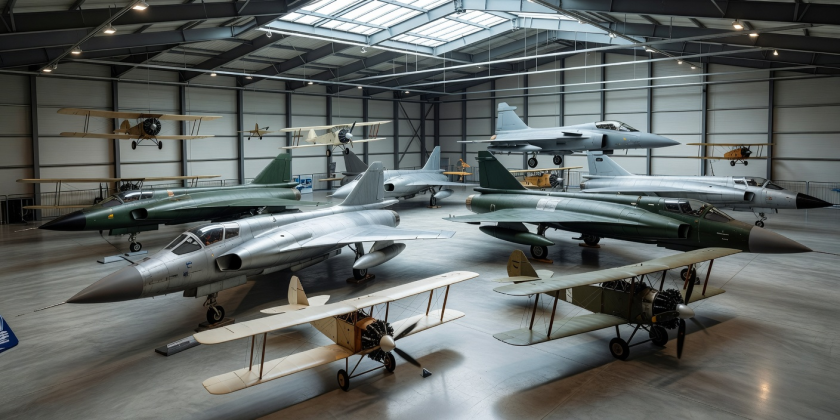
Geographic Distribution and National Roles
Nordic aviation museums reflect distinct national defense requirements and geographical realities. Northern European airspace demanded specialized cold-weather operations, remote-base logistics, and robust maritime reconnaissance. Consequently, collections in this region preserve aircraft engineered or modified for harsh meteorological environments.
Sweden maintains expansive state collections, primarily centered on institutions such as the Swedish Air Force Museum (Flygvapenmuseum) in Malmslätt. These holdings document domestic industrial output, notably airframes designed by Saab to operate from road runways during the Cold War. In Norway, institutions such as the Norwegian Aviation Museum (Norsk Luftfartsmuseum) in Bodø curate both civil transport history and NATO northern-flank defense operations. Finnish facilities, including the Finnish Aviation Museum in Vantaa and the Air Force Museum in Tikkakoski, reflect unique procurement histories that bridged Western and Soviet aircraft types.
Danish collections, such as Danmarks Flyvemuseum in Stauning, emphasize civil coastal patrol, glider aviation, and Royal Danish Air Force transition types. Iceland, lacking a military air force, focuses its preservation efforts at Akureyri and Reykjavík on search-and-rescue aviation, early North Atlantic transiting flights, and lifeline island-to-island domestic services.
Collection Typologies Across Hangar Facilities
Museum collections in Scandinavia and the wider Nordic territory are divided into five main technical categories:
- Front-Line Interceptors: Jet aircraft designed for rapid scramble times and dispersion, including the Saab Draken, Saab Viggen, and Gloster Meteor variants.
- Arctic Bush and Transport Aircraft: Floatplanes, ski-equipped transports, and rugged multi-engine haulers used to supply isolated northern settlements.
- Rotary-Wing and Maritime Patrol: Helicopters and flying boats dedicated to offshore air-sea rescue, anti-submarine surveillance, and fisheries protection.
- Propulsion Test Stands: Radial piston engines, early turbojets, and turbofans sectioned for didactic display.
- Ground Support and Navigational Stations: Mobile radar units, radio beacons, cold-weather pre-heaters, and snow-clearing vehicles essential for northern airfield operation.
Institutional Preservation Versus Environmental Realities
Operating museum hangars in northern latitudes presents substantial technical challenges. Severe winter temperatures require continuous climate regulation to prevent condensation cycles that accelerate internal galvanic corrosion. Large cavernous buildings with high ceilings make thermal stabilization expensive and mechanically difficult.
Institutional facilities prioritize static structural integrity over mechanical flight readiness. Decommissioned aircraft displayed indoors avoid ultraviolet degradation of acrylic canopies and fabric control surfaces. Conversely, airframes displayed as outdoor gate guardians face rapid paint degradation, water ingress, and structural fatigue from freeze-thaw cycles.
Comparison: National Archival Emphases
| Nation | Primary Strategic Focus | Key Aircraft Technologies | Typical Facility Type |
|---|---|---|---|
| Sweden | Armed neutrality, domestic manufacturing | Delta wings, thrust reversers, road-base avionics | Purpose-built state museum hangars |
| Norway | NATO northern perimeter, polar civil lines | High-altitude reconnaissance, maritime search radar | Dual-hall civil and military complexes |
| Finland | Post-war balance, frontier border patrol | Mixed Western and Eastern bloc powerplants | Operational airport perimeter hangars |
| Denmark | Baltic surveillance, NATO tactical support | Allied jet fighters, maritime rescue amphibians | Regional aerodrome preservation halls |
| Iceland | Transatlantic routing, extreme weather rescue | Long-range navigational instruments, rotorcraft | Aero club and airfield municipal archives |
What to Know When Evaluating Nordic Flight Museums
Researchers evaluating collections in this region should consider three factors:
- Access Permissions: Reserve collections and technical document archives frequently require advance booking, as they are housed in off-site military depot shelters.
- Seasonal Variations: Smaller regional hangars in northern Scandinavia often operate reduced heating and restricted winter access hours.
- Authenticity Variations: Some displayed airframes bear replacement parts or post-war export paint schemes; verify original airframe serial tags before recording historical provenance.
Related Technical Registers
Cross-reference museum inventories with specific airframe technical conditions and conservation records.
Need Specific Institutional Archival Data?
Submit documentation requests, archive corrections, or hangar location inquiries directly to our cataloguing desk.
Contact Archive Operator