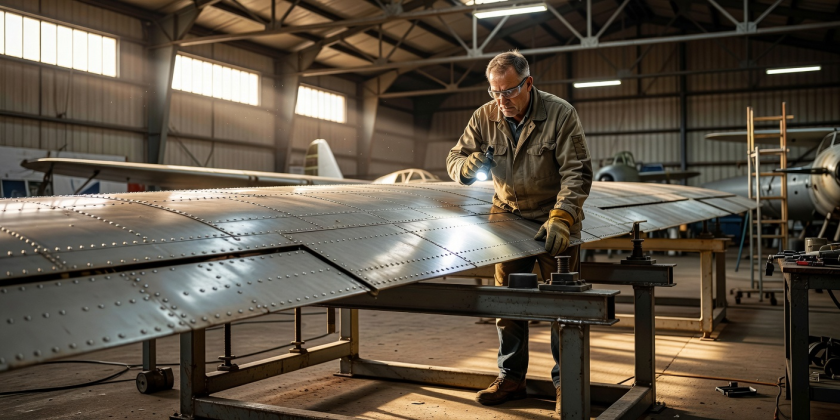
Conservation Versus Restoration: A Critical Distinction
In professional aeronautical curatorship, conservation and restoration represent opposing philosophies. Failing to distinguish between them leads to historical loss and structural alteration.
Conservation involves arresting decay, stabilizing existing chemical and mechanical states, and retaining original materials without modification. The conservator preserves battle damage, field repairs, worn cockpit coatings, and oxidization patinas. The objective is to stabilize the artifact for future research.
Restoration involves returning an aircraft to a specific earlier physical state by repairing damaged components, fabricating missing assemblies, and applying fresh coatings. While restoration produces an aesthetically complete display, it often destroys authentic evidence, including original factory stenciling, tool witness marks, and period hardware.
Structural Integrity and Corrosion Control
Aviation conservators face aggressive material degradation. The primary threat to metal airframes is galvanic corrosion, which occurs when dissimilar metals—such as steel fasteners driven into aluminium spar caps—interact in humid air.
Controlled preservation programs execute the following protocols:
- Non-Destructive Evaluation: Utilizing eddy-current testing, ultrasonic thickness gauges, and borescope cameras to inspect internal wing cavities and spar webs without structural dismantling.
- Corrosion Arrest: Chemically neutralizing active surface corrosion using mild, non-acidic chelating agents rather than abrasive media blasting, which strips protective alclad coatings.
- Dehumidification Systems: Installing desiccant dehumidifiers inside closed cockpits and fuselage cavities to maintain relative humidity strictly between 40% and 45%.
- Stress Relief: Suspending landing gear assemblies on padded floor cradles to prevent tire flat-spotting, hydraulic strut seal blowouts, and oleo casing deformation.
Authenticity and Documented Evidence
Preservation teams must adhere to manufacturer documentation and certified engineering blueprints. Substituting modern hardware—such as substituting metric fasteners for original Imperial or German DIN standards—compromises historical accuracy.
Qualified teams document every intervention in a conservation dossier. When an unstable component must be removed, it is tagged, catalogued, and stored alongside the primary airframe rather than discarded.
Comparison: Static Display vs. Operational Airworthy Restoration
| Parameter | Static Museum Conservation | Operational Flight Restoration |
|---|---|---|
| Primary Goal | Long-term physical survival of original material | Safe compliance with civil aviation flight rules |
| Component Replacement | Strictly prohibited unless structurally unstable | Frequent replacement of original lifed parts |
| Systems Status | Drained, neutralized, inert | Pressurized, fueled, electrically active |
| Fatigue Risk | Negligible under supported static storage | High risk from engine heat, vibration, G-loads |
| Historical Integrity | Maximal preservation of original surfaces | Substantial alteration and synthetic modernization |
What to Know About Airframe Preservation Ethics
When assessing historical projects, researchers should verify three key ethical standards:
- Reversibility: All chemical consolidants, surface waxes, and preservative oils applied to an airframe must be completely reversible with mild solvents.
- Transparency: Any replacement panel, fabricated rib, or simulated instrument must be clearly stamped or recorded in public catalogue registers.
- Non-Operative Safety: Pyrotechnic items, such as ejector charges and fire extinguishing squibs, must be inerted by licensed defense personnel without cutting through structural fairings.
Related Technical Registers
Review documentary resources and private collection practices.
Technical Conservation Inquiries
For inquiries regarding material preservation records or inspection standards, connect with our technical research team.
Contact Archive Operator