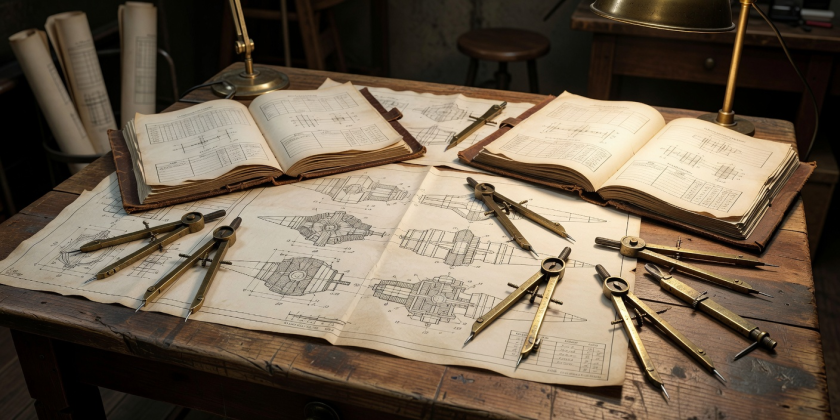
Documentary Material as Primary Evidence
An aircraft airframe represents an incomplete record without its documentary context. Aviation archives store the paper and photographic materials that establish when, how, and by whom an aircraft was designed, built, and operated.
In Northern Europe, these holdings are preserved in national state archives, regional military depots, and university research collections. These repositories contain vital technical records:
- Original Engineering Tracings: Linen and vellum engineering drawings detailing wing ribs, hydraulic routing, and electrical schematics produced by manufacturers such as Saab, Valmet, and flygindustri consortia.
- Flight Test Reports and Dispatch Logs: Official logbooks recording test runs, engine replacement cycles, airframe overhauls, and weather incident notes.
- Pilot Logbooks and Mission Briefings: Primary personal records detailing patrol patterns across the Baltic Sea, North Sea, and Arctic approaches.
- Maintenance Depots Manuals: Airframe repair manuals (Illustrerte Delekataloger) detailing parts breakdown, tolerances, and authorized repair procedures.
Avionic Artifacts, Navigation Gear, and Uniforms
Archives also preserve smaller aviation artifacts that require specialized physical storage conditions:
Cockpit Instrumentation: Gyroscopic turn-and-bank indicators, barometric altimeters, artificial horizons, and fuel-flow meters. Radium-dial instruments from the 1930–1955 era present low-level radiological concerns, requiring monitored negative-pressure storage cabinets.
Navigation Systems: Mechanical drift sights, sextants, dead-reckoning computers, and early radio direction-finding loop antennas utilized during trans-polar crossings.
Flight Clothing and Textiles: Leather flight jackets, sheepskin-lined flight suits, survival suits, and high-altitude G-suits. These items are vulnerable to pest damage, humidity, and acid migration from cardboard boxes, necessitating acid-free tissue wrapping and controlled climate vaults.
Cataloguing, Provenance, and Digital Surrogates
Aviation artifact cataloguing requires strict provenance documentation. An unsigned flight instrument has minimal historical value without documentation linking it to a specific aircraft serial number or operational unit.
Digitization programs create high-resolution preservation copies of fragile paper assets, including blueprints and glass-plate negatives. This makes the technical content accessible to researchers while shielding the original fragile media from light exposure and physical handling.
Overview of Archive Media Categories
| Artifact Category | Storage Requirements | Primary Degradation Risk | Research Role |
|---|---|---|---|
| Blueprints & Vellum | 18°C, 35–45% RH, dark plan drawers | Acid burn, brittleness, ink fading | Structural airframe restoration reference |
| Glass Plate Negatives | Cold storage, vertical archival sleeves | Emulsion flaking, mechanical cracking | Visual confirmation of wartime squadron markings |
| Avionic Radium Gauges | Shielded, ventilated metal cabinets | Phosphor breakdown, radiological gas | Instrument panel layout and ergonomics |
| Flight Logbooks | Acid-free boxes, buffered folders | Paper acidification, ink bleeding | Individual airframe operational history |
What to Know When Consulting Aviation Archives
Researchers consulting non-airframe archival records should note three key standards:
- Handling Regulations: Nitrile gloves must be worn when inspecting photographic negatives, blueprints, and bare metal artifacts to prevent skin oil transfers.
- Security Classifications: Cold War airbase site schematics and radar surveillance protocols remain subject to state security classifications; verify declassification status before requesting access.
- Reproduction Protocols: Digital cameras without flash may be permitted for private research, whereas publishing high-resolution manufacturing schematics requires formal copyright clearance from relevant corporate successors.
Related Technical Registers
Cross-reference documentation holdings with museum collections and private registers.
Archival Document Search Requests
Submit aircraft serial query requests, flight manual index searches, or archival reference inquiries to our research team.
Contact Archive Operator